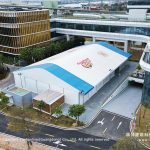
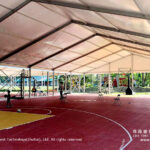
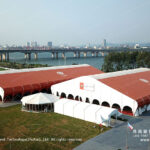
A clear span tent built specifically for basketball delivers a regulation court under a single roof with zero interior posts. The column-free span clears the three-point arc and sidelines, allowing the game to proceed exactly as in a permanent indoor arena. For schools, sports clubs, and tournament organizers that need a playable court on short notice, this portable structure provides a reliable solution. The absence of center poles means the full court surface remains unobstructed for dribbling, passing, and shooting, matching the playing experience of a traditional gymnasium. Browse the clear span basketball court tent for the complete court-specific configuration. For broader venue planning, compare commercial sports event tents.
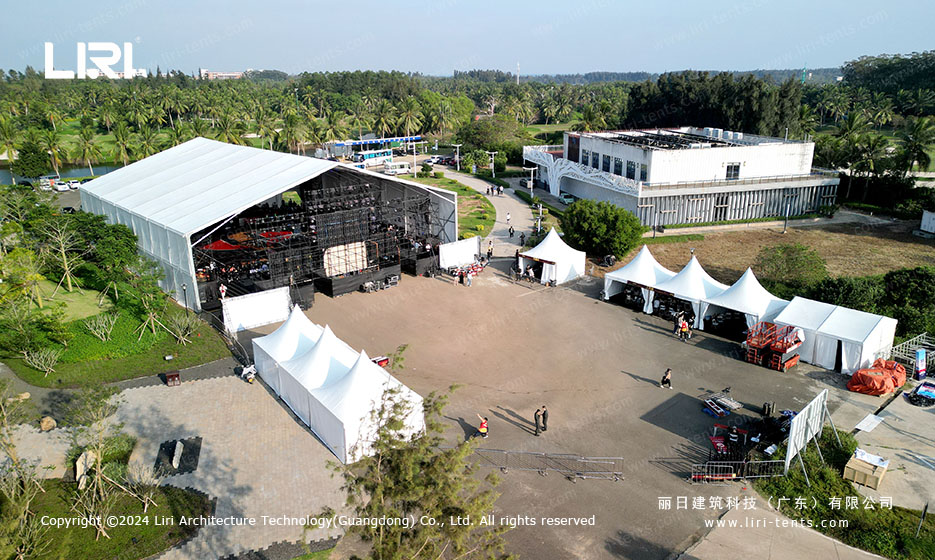
Court Dimensions and Clearance Specifications
A regulation basketball court measures 28m by 15m with required runoff space on all sides. The tent bay uses 5m modular spans to clear the full playing area without interior supports. Eave height ranges from 4m to 6m, providing headroom for sideline spectator seating, scoreboard suspension, and banner hanging. The roof membrane is 650 to 850 g/m² PVC, flame rated to DIN 4102 B1 for public assembly compliance. The same frame system appears in the clear span basketball court at Liuyang Rucker Park, demonstrating proven real-world court performance for both training and competitive play.
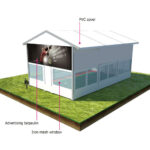
The 6061-T6 aluminum frame carries truss systems for broadcast lighting and house lights, with HVAC units clipping in for temperature control during winter play. Wood or synthetic sports flooring lays on beam supports above the ground surface, providing the same bounce and grip as a permanent gym floor. Transparent sidewall panels bring in natural daylight to reduce artificial lighting load during daytime games, lowering operational costs for extended tournament schedules. No foundation is required — weight plates or stakes anchor the frame, leaving the site clean after the season ends. This zero-footprint approach is particularly advantageous for schools and clubs operating on leased land where permanent construction is not permitted.
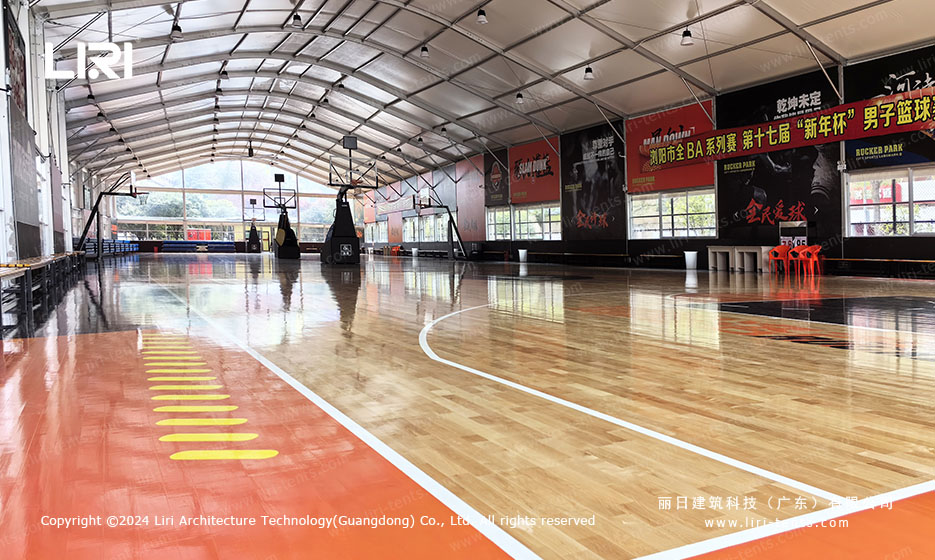
Flooring, Lighting, and Climate Systems Compared
Three flooring options suit different competition levels: interlocking wood panels for professional-grade play, synthetic sports tiles for multi-use facilities, and plywood-over-beam decks for practice courts. All three systems sit above ground level, keeping the playing surface dry and level regardless of site conditions. Lighting truss attaches to the frame without floor stands, eliminating trip hazards along the sidelines. Clip-in HVAC units maintain playing temperature between 15°C and 22°C, with insulated wall panels reducing heat loss during cold months. The complete system matches the setup used in the 25x20m Shanghai sports event tent, which accommodates basketball alongside other court sports under the same roof structure.
Hoop mounts fix directly to the frame structure without floor-penetrating posts, preserving the clear playing area. Power runs through overhead busbars, keeping cables off the court surface. Service doors for player entry and equipment access cut into the wall panels without compromising frame integrity. Line markings are painted or taped onto the flooring surface and can be changed between sports, allowing the same structure to host basketball, volleyball, or badminton tournaments as the calendar demands.
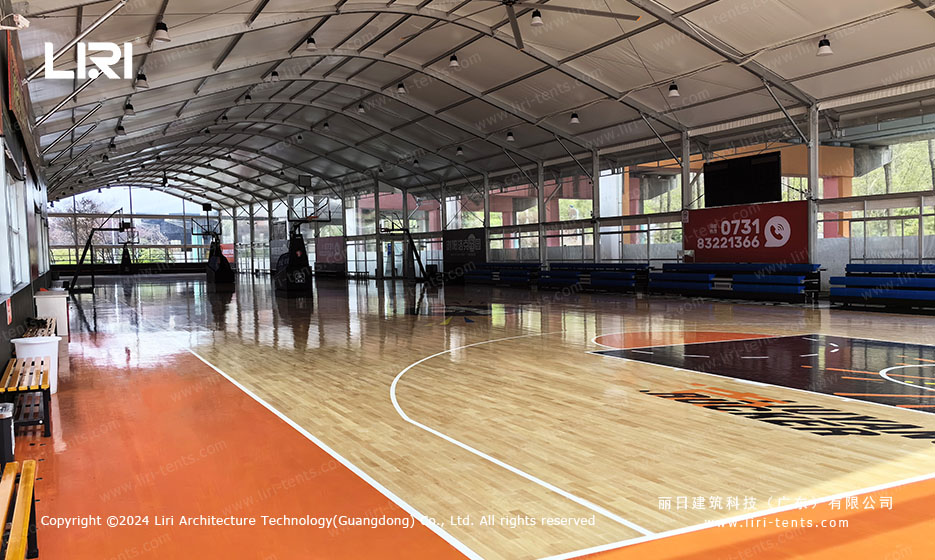
Tournament and League Deployment
For tournaments, school leagues, and community programs lacking a permanent gymnasium, the portable court fills the gap. The frame and floor packs into transport bundles that a crew relocates between host sites within days. One purchase serves a full season circuit, eliminating rental costs at each venue. The sports hall event tent uses the same construction method, allowing crews to build basketball, volleyball, or badminton courts from the same frame kit. This interchangeability reduces overall equipment investment for multi-sport organizations running year-round programming.
Getting started requires the court size, expected seating capacity, and planned tournament dates. The supplier sets bay span, eave height, and flooring type based on these parameters. A site survey confirms ground conditions for anchoring and checks clearance for overhead lighting truss. Delivery arrives as labeled frame, floor, and cover bundles that a trained crew assembles without cranes. Request flooring type and heating specifications early in the planning stage, as those components determine play quality more than the roof structure.
Frequently Asked Questions
What tent size fits a full basketball court with player run-off space?
A clear span of approximately 30m by 18m accommodates a regulation court with sideline runoff and spectator space inside one post-free bay. Larger spans can include bleacher seating on both sides for tournament play. Schools hosting regional competitions should specify the larger dimension to accommodate officials tables and media areas.
Is the portable court surface suitable for competitive basketball games?
Yes. Wood or synthetic sports flooring on beam supports provides stable, consistent bounce that meets competitive standards. The frame holds hoop mounts and line markings without interior posts interfering with play. Many regional basketball associations have approved these temporary courts for sanctioned league games and qualifying tournaments.
Can the basketball tent be used for winter league play?
Yes. Insulated sidewall panels and clip-in HVAC systems maintain comfortable playing temperatures during cold months. Transparent panels bring natural daylight into the space during daytime games. Winter league organizers should plan heating capacity based on the local climate and expected spectator load.
How long does it take to relocate the basketball court to a new host site?
A trained crew dismantles, packs, and re-erects the complete court structure at a new location within two to three days, depending on site conditions and crew size. Multi-court tournaments benefit from having dedicated transport and setup teams that move between venues on a rotating schedule.
What maintenance does the tent structure require between basketball seasons?
The aluminum frame requires no painting or rust treatment. PVC covers clean with mild detergent and water. Floor panels should be stored in dry conditions between uses to maintain surface quality. Annual inspection of cover seams and connector hardware is recommended before each season.
→ Browse Large Sports Arena Tents
Send the site details, required size and operating season for a tailored specification.
{“@context”:”https://schema.org”,”mainEntity”:[{“acceptedAnswer”:{“text”:”A clear span of approximately 30m by 18m accommodates a regulation court with sideline runoff and spectator space inside one post-free bay. Larger spans can include bleacher seating on both sides for tournament play. Schools hosting regional competitions should specify the larger dimension to accommodate officials tables and media areas.”,”@type”:”Answer”},”name”:”What tent size fits a full basketball court with player run-off space?”,”@type”:”Question”},{“acceptedAnswer”:{“text”:”Yes. Wood or synthetic sports flooring on beam supports provides stable, consistent bounce that meets competitive standards. The frame holds hoop mounts and line markings without interior posts interfering with play. Many regional basketball associations have approved these temporary courts for sanctioned league games and qualifying tournaments.”,”@type”:”Answer”},”name”:”Is the portable court surface suitable for competitive basketball games?”,”@type”:”Question”},{“acceptedAnswer”:{“text”:”Yes. Insulated sidewall panels and clip-in HVAC systems maintain comfortable playing temperatures during cold months. Transparent panels bring natural daylight into the space during daytime games. Winter league organizers should plan heating capacity based on the local climate and expected spectator load.”,”@type”:”Answer”},”name”:”Can the basketball tent be used for winter league play?”,”@type”:”Question”},{“acceptedAnswer”:{“text”:”A trained crew dismantles, packs, and re-erects the complete court structure at a new location within two to three days, depending on site conditions and crew size. Multi-court tournaments benefit from having dedicated transport and setup teams that move between venues on a rotating schedule.”,”@type”:”Answer”},”name”:”How long does it take to relocate the basketball court to a new host site?”,”@type”:”Question”},{“acceptedAnswer”:{“text”:”The aluminum frame requires no painting or rust treatment. PVC covers clean with mild detergent and water. Floor panels should be stored in dry conditions between uses to maintain surface quality. Annual inspection of cover seams and connector hardware is recommended before each season.”,”@type”:”Answer”},”name”:”What maintenance does the tent structure require between basketball seasons?”,”@type”:”Question”}],”@type”:”FAQPage”}