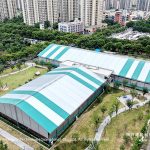
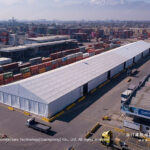
Sports venues operate on cycles: a training block, a tournament weekend, or a finals series that packs more people than the permanent stands hold. A clear span tent delivers column-free floor space that matches that cycle. It goes up in days, stands for a season, and leaves no trace when it moves. For clubs managing academy programs or municipalities hosting regional meets, this approach provides flexible capacity without committing to a concrete structure.
Bay Configurations for Courts and Fields
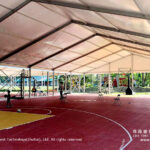
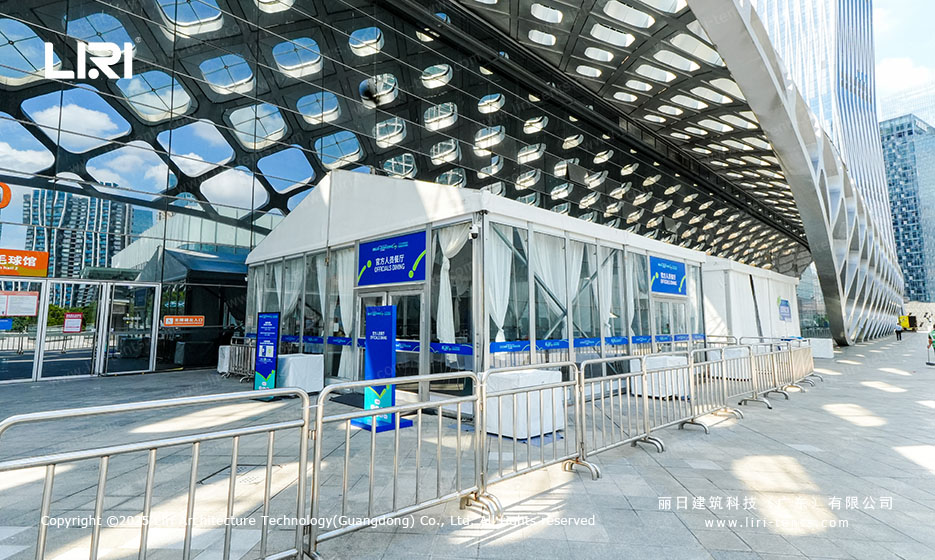
The structure uses 3-meter or 5-meter bay spacing with eave heights adjustable from 3 to 6 meters. This range clears standard basketball courts, indoor running tracks, badminton layouts, and small-sided football pitches. The aluminum 6061-T6 frame carries a PVC roof cover rated at 650 to 850 g/m² with DIN 4102 B1 flame certification. Sidewall panels swap between solid PVC for focused training, transparent sections for daylight, and glass panels for a premium spectator environment. Service doors integrate at any bay for athlete and equipment access.
A single frame configuration serves both training sessions and match-day operations. Wall panels convert the enclosure from a closed practice hall to an open-sided spectator pavilion in hours. This modular approach means one inventory covers multiple uses across the season. A venue with three bay units can run a junior academy session in one, a physio and recovery zone in the second, and a catered VIP area in the third, all simultaneously. Review the multi-use sports exhibition tent for a similar modular layout designed for events that shift between athletic and commercial use.
Structural Specs and Environmental Ratings
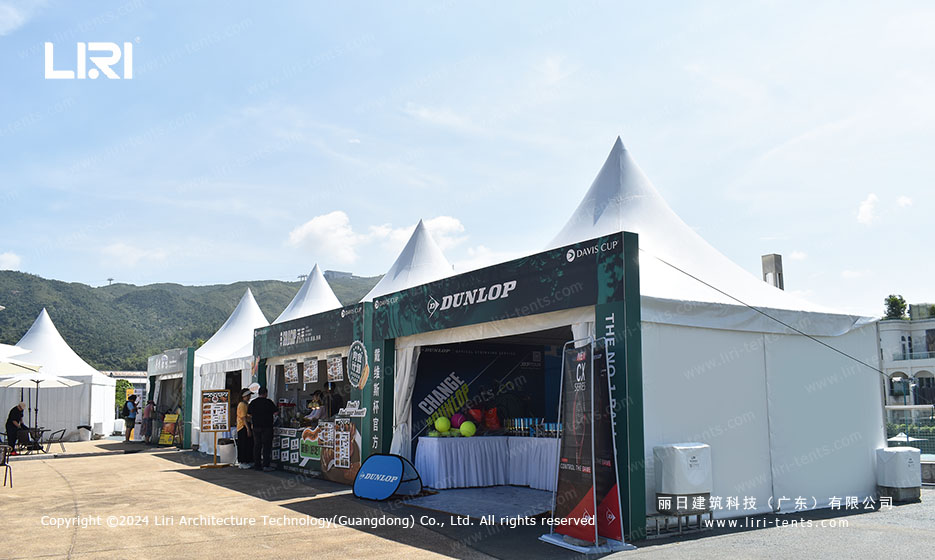
The frame anchors to the ground using weight plates on hard surfaces or ground stakes on turf. No concrete foundation is required. Wind load tolerance reaches 80 to 100 km/h depending on bay length and sidewall configuration. Snow load capacity spans 0.3 to 0.5 kN/m², covering most temperate and winter climate zones. For colder regions, the frame supports integrated HVAC systems and overhead lighting trusses for evening and cold-month operations. These ratings have been verified through field installations across four climate zones including tropical coastal sites and alpine winter venues.
Flooring options include beam-supported cassette panels and marine-grade plywood laid above the ground surface. Line markings for specific sports can be applied directly to the floor surface and removed when the use changes. Power distribution runs through floor ducts or overhead busbar systems, keeping cables clear of walkways and playing areas. Drainage follows the natural site slope, with no trenching or pipework required. The high-altitude winter sports tent demonstrates how basketball arena tent structure these specifications perform under extreme weather conditions including heavy snowfall and high winds.
Use Cases Across the Sports Calendar
Club academies use clear span tents as covered training grounds during off-season months when outdoor fields are unavailable. A rugby academy in a temperate climate can run contact skills sessions through winter without losing field time to frost. Tournament organizers deploy them as overflow seating zones, media centers, and athlete warm-up areas adjacent to the main competition venue. For multi-day events, a linked bay configuration creates a single campus that houses registration desks, catering concessions, recovery areas, and broadcast booths under one roof system.
The real advantage lies in reusability. After the event concludes, the frame disassembles into labeled bundles and ships to the next location. A venue operator can plan a full year of programming around one tent system, deploying it for indoor soccer in winter and converting it to a VIP hospitality pavilion for summer tournaments. Municipalities use the same structure for community sports festivals on weekends and school athletics programs on weekdays. The international sports training venue solution provides a case study in how modular clear span tents support year-round athletic programming across different climates and competition levels.
What sports can be hosted inside a clear span tent?
Basketball, badminton, volleyball, table tennis, indoor athletics, and small-sided football all fit within standard bay dimensions of 3 to 6 meters eave height. The column-free interior means court markings remain uninterrupted. Wall panel selection can be adjusted for different visibility and ventilation needs per sport. For larger configurations, multi-bay setups accommodate indoor tennis courts and full-size handball pitches.
Does the ground need preparation before installation?
Minimal preparation is required. The site must be level and clear of debris. The frame uses weighted plates or ground stakes instead of poured footings, which means the original surface remains unchanged after removal. Most installations begin within 48 hours of site approval. For grass surfaces, the tent footprint is rotated between installations to prevent long-term turf damage.
Can the tent be used for non-sporting events between seasons?
Yes. The same structure converts to an exhibition hall, trade show pavilion, or corporate hospitality venue by swapping sidewall panels and interior layouts. This dual-use capability improves return on investment for venue operators who manage diverse event calendars. Some operators achieve 80 percent utilization across sporting and commercial bookings within the first year of ownership.
How quickly can the structure be relocated?
A trained crew of six can dismantle a 30-meter bay in two days. The frame, cover, and floor pack into standard shipping containers and can be reinstalled at a new site within one week. This turnaround makes the system practical for touring competitions and seasonal sport circuits. For rapid deployment scenarios, pre-labeled connector sets reduce setup time by roughly 30 percent after the first installation.
→ Browse Sports Event Tent Solutions
Send the site details, required size and operating season for a tailored specification.