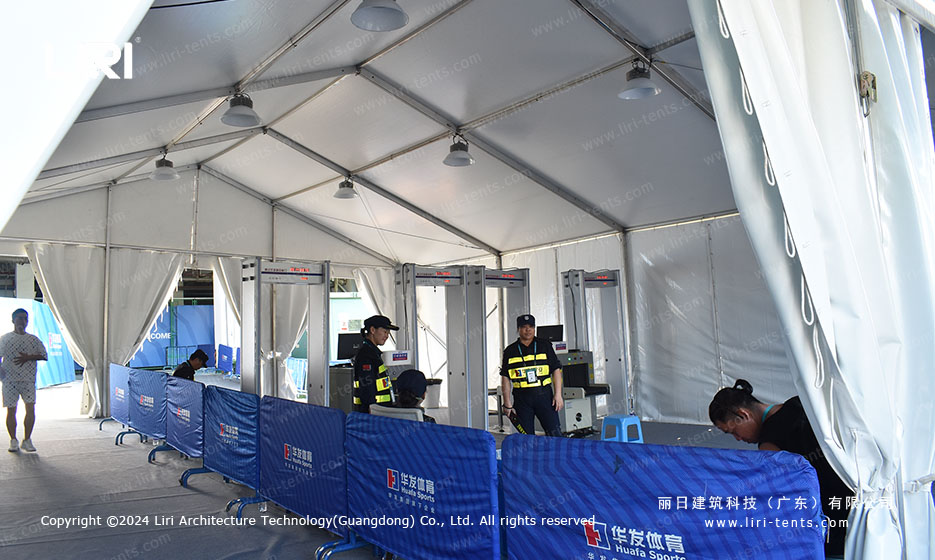
When the Davis Cup tour rolled into Hengqin, the organisers needed a small-footprint structure to turn a sponsor plaza into a branded hospitality room in under two hours.
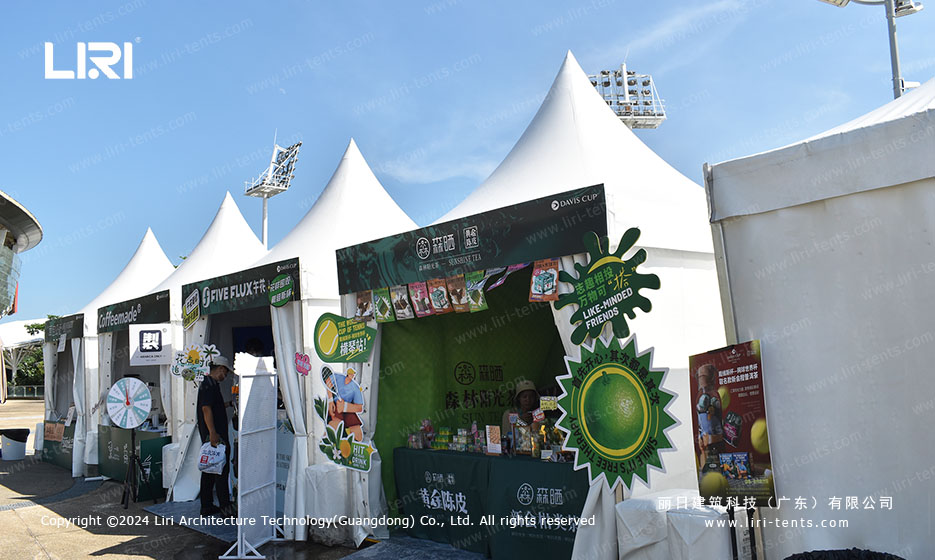
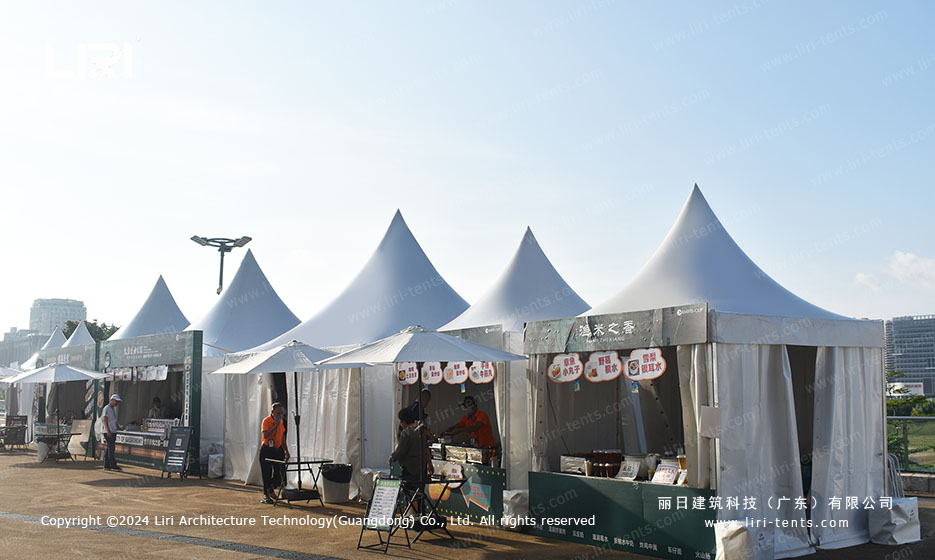
A row of white pagoda tents, 3m by 3m each, did exactly that. Each peak carried a backlit banner for Dunlop, the official ball partner.
The supplier chose a high-peak pagoda profile in bright white PVC, lined the canopies end-to-end along the gallery, and tied each module with custom-printed valance strips to read as one cohesive sports event tent village.
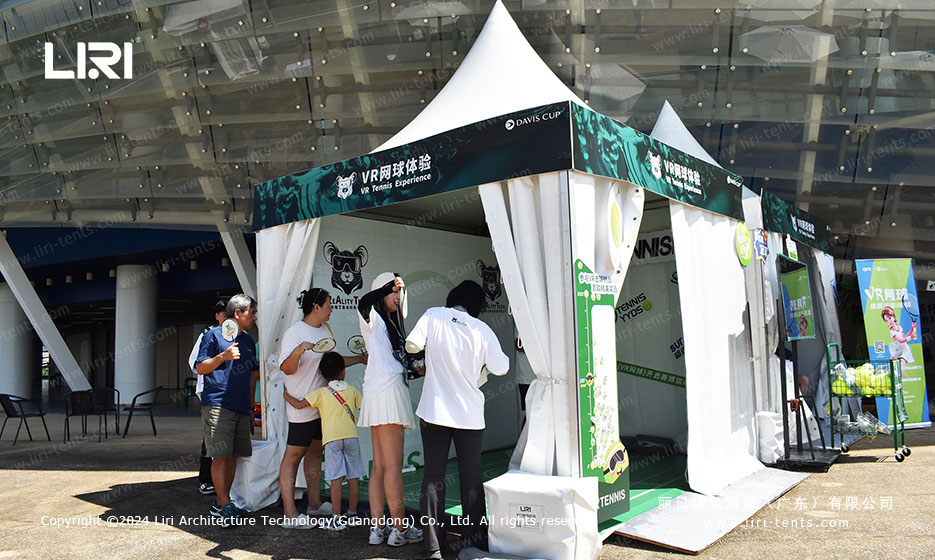
Two units were re-skinned as an immersive VR tennis experience. The high ceiling of the sport tent cleared the 2.4m sensor rig, while a blackout liner kept sun glare off the projection screens.
How the Tent Village Was Configured for Matchday Operations
The Hengqin site was tight: a paved gallery at court level plus a small service courtyard behind the main stand. The supplier solved it with a mixed tent village — small pagoda tents for sponsor booths and fan zones, plus larger temporary halls.
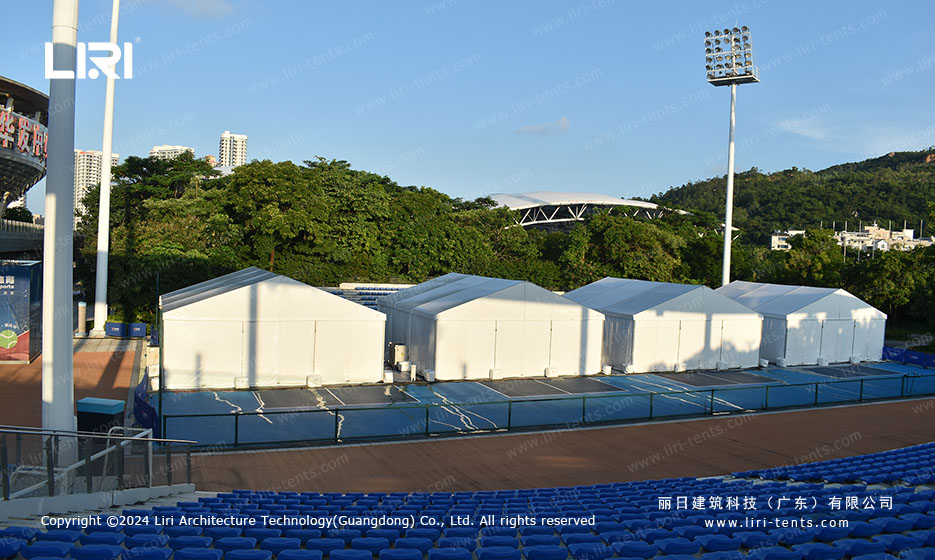
For spectator-facing activations, the team selected 3m x 3m and 4m x 4m pagoda modules, light enough to reposition between sessions, with bolt-down base plates that left the gallery floor undamaged. For staff-facing functions, they used 5m x 5m clear span halls for security screening, media check-in and first-aid.
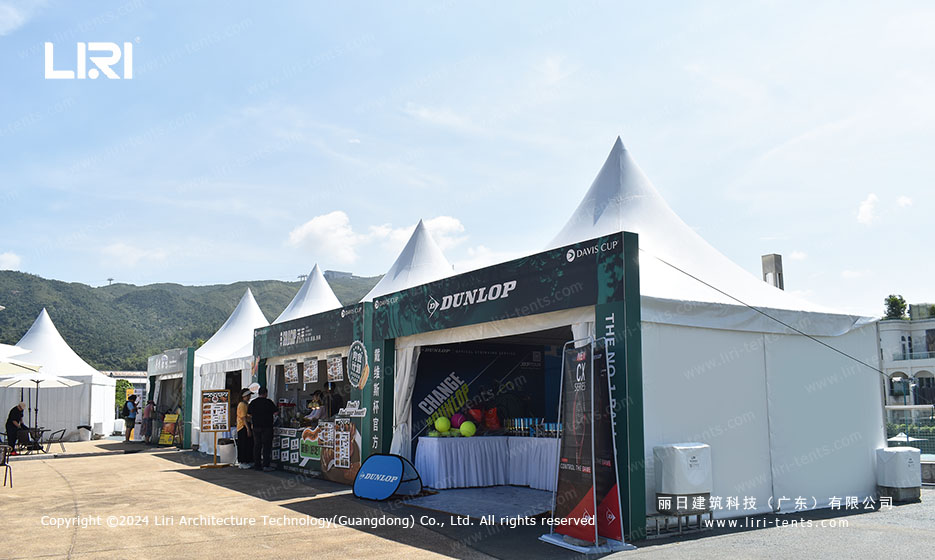
The clear span multi-use event tent approach gave the organisers something the venue alone could not: a continuous, column-free corridor hosting sponsor booths, fan zones and service counters in one sweeping line. Modules anchored to the existing concrete with removable weight plates, and the white PVC roof fabric dropped the surface temperature by roughly 8 to 10 degrees versus direct sun.
Materials and Setup Time That Held Up Under Tour Pressure
The Hengqin stop was a rehearsal for two more Davis Cup events later in the season, so the build had to be replicable. The supplier shipped a single container of event tents for sale components: aluminium alloy frames, 850 g/m² white PVC roof panels, 650 g/m² sidewalls, steel base plates.
Twelve crew members erected the village in roughly nine working hours, including banner installation and electrical fit-out. The pagoda units went up first because each pair could be deployed in under 40 minutes by a four-person team. The largest single module — a 10m x 15m media centre — took about 90 minutes from unload to anchor.
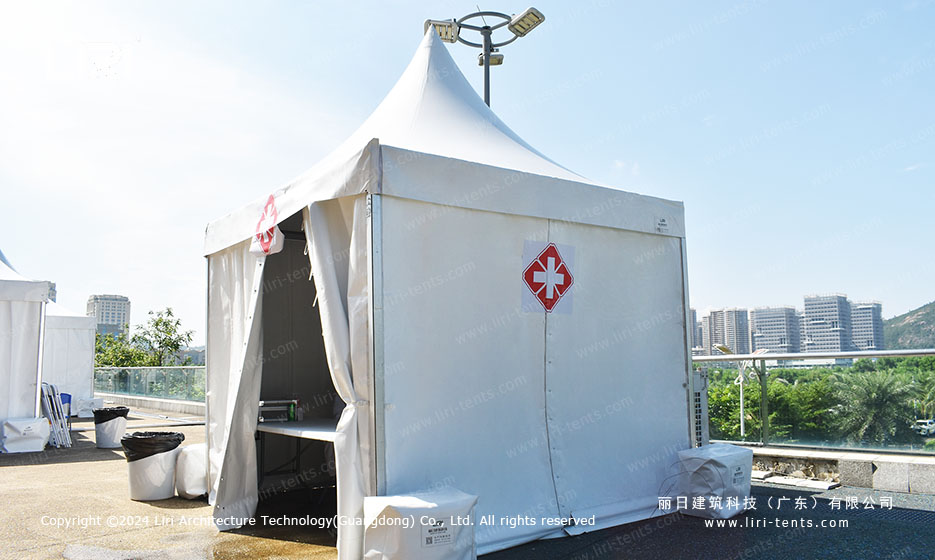
One module was set aside for the on-site medical station. The first-aid tent stood on a 4m x 4m footprint with a red cross panel riveted to the sidewall and a stretcher-width doorway facing the courts. Inside, two adjustable cots, an AED wall mount and a stainless instrument table.
What Organisers and Sponsors Said About the Setup
By the end of the first day, the event team was treating the tent village as the second venue of the tournament. The Dunlop activation counter logged more than 1,200 visitor scans, and the VR experience queue stayed 20 to 30 minutes deep for most of match hours. The food and beverage row served roughly 2,800 covers on the busiest day without queue overflow.
The activation spaces used the same promotion exhibition pagoda tent family the supplier ships for roadshow campaigns. The key tournament takeaway, according to the operations lead, was that a well-specified festival tent package can replace a permanent hospitality build at a fraction of the install cost.
What Tour Operators Should Specify When Booking a Tennis Event Tent
If you are planning a tour stop, a club-level exhibition, or a sponsor activation at a tennis venue, three numbers drive every other decision. The total linear metres of branded canopy along the gallery, the peak height of the tallest module for broadcast clearance, and the anchor method for the court surface.
Most tour operators now specify a movable easy up sport event tent for tennis package as the default for short-format events. The frame geometry, bolt-and-pin connectors and one-piece roof panels are designed for repeated install cycles. A typical 3m x 3m pagoda packs into four carry bags and weighs under 90 kg total, so a single pickup can move an entire activation row between sessions or between tour stops.
Field Layout and Security Flow at Gate 4
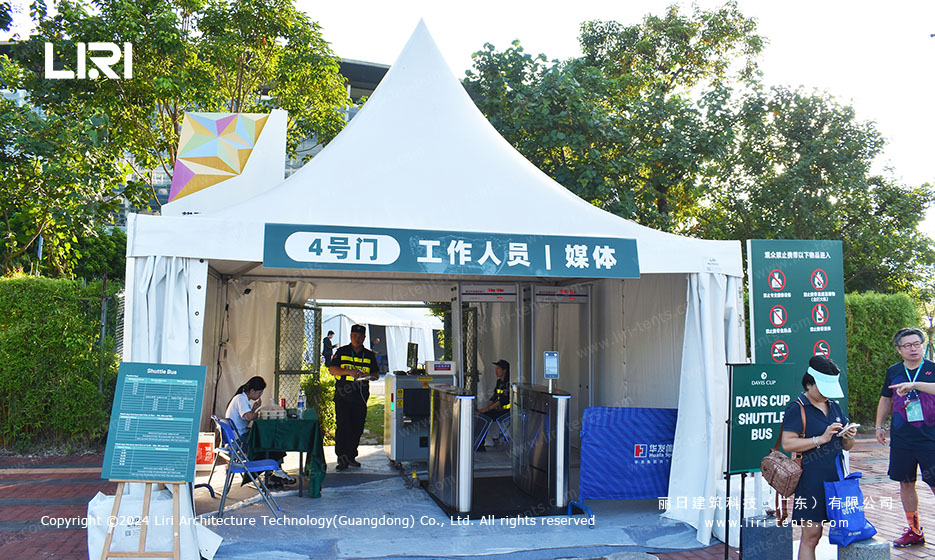
The Gate 4 entry was the busiest checkpoint of the tournament, handling staff, media and credentialed contractors through three parallel turnstiles. The supplier installed a 5m x 5m canopy so scanners, bag-check tables and a short queue lane all sat under cover. The canopy height cleared the 2.6m walk-through metal detector with margin for cabling.
What made the gate work operationally was the sidewall configuration. Front and rear walls open for pedestrian flow, the side facing the concourse closed with a window panel for the credentials desk, the side facing the court fully closed with a branded banner. The team reused the same hardware they had used for the sponsor booths earlier in the week. That kind of brand activation flexibility is often the difference between a setup that scales and one that does not.
Frequently Asked Questions
Q: What size pagoda tent is most suitable for a single sponsor booth at a tennis event?
A: A 3m x 3m module is the most common starting point. It fits one demo counter, two staff and a backwall banner, and pairs side-by-side to extend a sponsor corridor. For a hospitality or sampling station with seating, a 4m x 4m or 5m x 5m footprint gives you a small standing-meeting area.
Q: How quickly can a tent village like the Davis Cup Hengqin setup be deployed?
A: A four-person crew installs a 3m x 3m pagoda in roughly 40 minutes, and a 10m x 15m hall in about 90 minutes. A full village of 8 to 12 modules, including sponsor wraps, lighting and signage, typically goes up in one working day with a 12-person team and comes down in half that time.
Q: Can these tents handle strong coastal wind at an outdoor tennis venue?
A: Yes, the standard frame is engineered for 100 km/h wind load with proper anchoring. At Hengqin, gusts reached 30 km/h through one afternoon session with no adjustment. For coastal tour stops, the supplier adds cross-bracing and weight plates rated to the local wind zone.
Q: Are these structures suitable for branded sponsor wraps and backwall printing?
A: They are designed for it. The PVC fabric accepts dye-sublimation and UV printing for sponsor logos, and roof and valance panels can carry full backlit graphics. The Hengqin setup used printed valance strips, sidewall banners and roof-edge signage all in the same fabric spec.
Q: How does the tent package ship between tour stops?
A: A standard 3m x 3m pagoda packs into four carry bags totalling under 90 kg. A full tour kit for a 10-to-12-module village, including a media hall and gate canopy, fits in a single 40-foot container. The supplier ships by sea for international tour legs and by road for regional events.