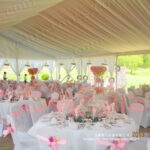
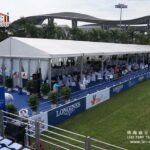
Buying an event tent is a capital and operating decision, not simply a comparison of roof shapes. A commercial buyer needs a structure that fits the site, the event program, the installation plan and the way the tent will be stored and reused. Start with the project brief, then compare suppliers against the same requirements.
Build the Commercial Buying Brief First
- Use: define whether the structure will serve exhibitions, hospitality, festivals, sports, corporate events or several formats.
- Site: record the available footprint, surface, access route, drainage, surrounding buildings and local operating limits.
- Layout: include guest areas, aisles, stages, booths, catering, storage, technical positions and emergency routes.
- Operating model: note how often the tent will move, who will install it and where frames, covers and accessories will be stored.
Use the clear span tent size guide to turn the brief into a usable floor plan before requesting prices.
Choose the Structure Around the Work It Must Do
A clear span event tent creates an open interior without center poles, which makes it useful for commercial layouts that change between events. Smaller frame, pagoda or dome structures can support entrances, registration, catering and satellite functions. The best mix depends on circulation, equipment, access and the intended reuse plan.
| Decision | What to compare | Why it matters |
|---|---|---|
| Frame system | Span, bay format, roof profile and compatible wall systems | Controls usable space and how the inventory can be reconfigured. |
| Site interface | Ground condition, anchoring approach, access and installation clearance | Determines whether the proposed structure can be installed on the actual site. |
| Interior package | Flooring, doors, walls, lighting, HVAC allowances and service zones | Turns a shell into an operational venue. |
| Project documentation | Drawings, component list, installation information and project-specific engineering | Supports review, handover and repeat setup. |
| After-sales plan | Spare parts, cover replacement, labeling, maintenance and technical support | Protects the value of an inventory used across multiple events. |
Ask for Project-Specific Engineering Information
Do not treat a generic product statement as approval for every location. Wind, snow, fire, occupancy and anchoring requirements depend on the structure, site and jurisdiction. Use the clear span tent engineering overview to prepare the questions that must be answered for the real project.
Compare Ownership with Rental
Buying can suit rental companies, venue operators and organizers that reuse compatible bays and accessories. Rental can be more practical for an isolated event or a project where local installation and short-term service are the main needs. Compare the full operating cost: transport, storage, inspection, installation labor, replacement covers and idle periods all belong in the decision.
Supplier Review Checklist
- Confirm the exact frame and cover specification included in the quotation.
- Request a component list and drawings for the proposed configuration.
- Clarify which flooring, doors, walls and accessories are included or optional.
- Define packing, labeling, shipping responsibilities and the receiving plan.
- Agree on installation guidance, inspection, maintenance and spare-part support.
- Check the project against local approval and operating requirements.
Review the event tent shipping and logistics guide before finalizing delivery responsibilities, and learn more about the event tent manufacturer behind the structure.
Request a Quote-Ready Review
Send the event use, site location, operating dates, required footprint, layout, access conditions and any available drawings. The team can compare suitable structures against the same commercial brief.
Continue the Buying Decision
Compare the event tent product range, review the boundary between used and new event tents, and assess the operating model in the rental company and venue operator guide.