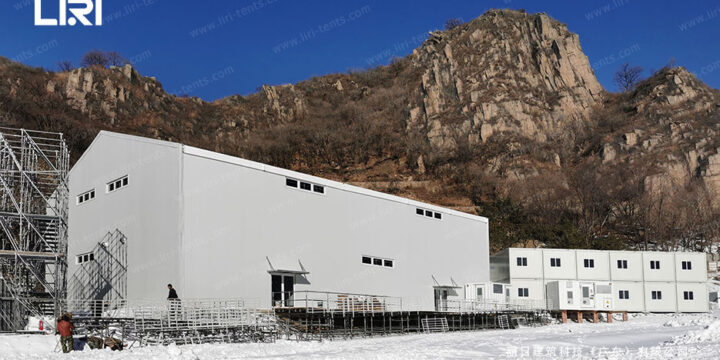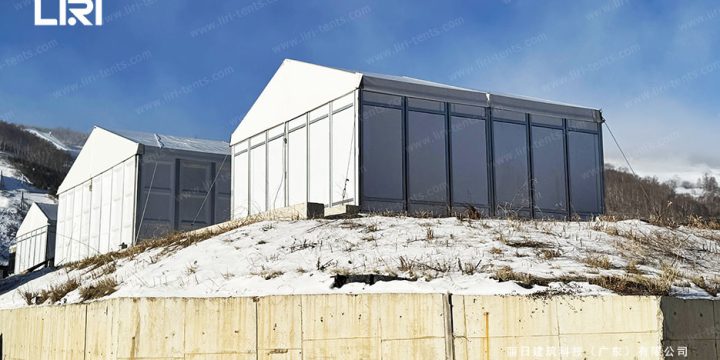
Hosting an event in winter means contending with snow loads, sub-zero temperatures, and wind that can tear through a standard tent. A winter event tent is purpose-built for these conditions — not just a regular tent with sidewalls, but a structure engineered from the start for cold-weather performance.
The structural demands are the starting point. In regions with significant snowfall, the roof frame must carry at least 0.5 kN/m² of snow load, which calls for high-strength aluminum profiles and a roof pitch that sheds accumulation. Anchoring on frozen or uneven ground requires heavy-duty systems — ground screws, ballast plates, or concrete blocks — that stay secure when the soil shifts. Wind is the other constant: an exposed winter site can see gusts that make lateral stability the deciding factor in whether an event goes ahead.
Temperature control separates a winter tent from a summer one. Rigid ABS wall panels and HVAC integration turn the interior into a properly climate-controlled space. This matters whether you’re running a high-altitude winter sports venue or a seasonal market that needs to keep customers comfortable through the coldest months. The difference between a tent people tolerate and one they enjoy comes down to insulation and heating capacity.
Winter tent structures generally use 6061-T6 aluminum frames paired with PVC roof fabric that stays flexible at -20°C. Spans range from 10m to 30m in clear span configuration, which eliminates interior columns and gives full freedom for event layout and crowd flow. A 30m winter tent we deployed handled sustained wind loading through a cold-season event — proof that when the engineering matches the conditions, winter events don’t have to mean compromise.
For projects where winter weather is a real risk rather than an afterthought, we provide engineering-led consultations. Get in touch to discuss snow load, anchoring, and insulation for your specific site.