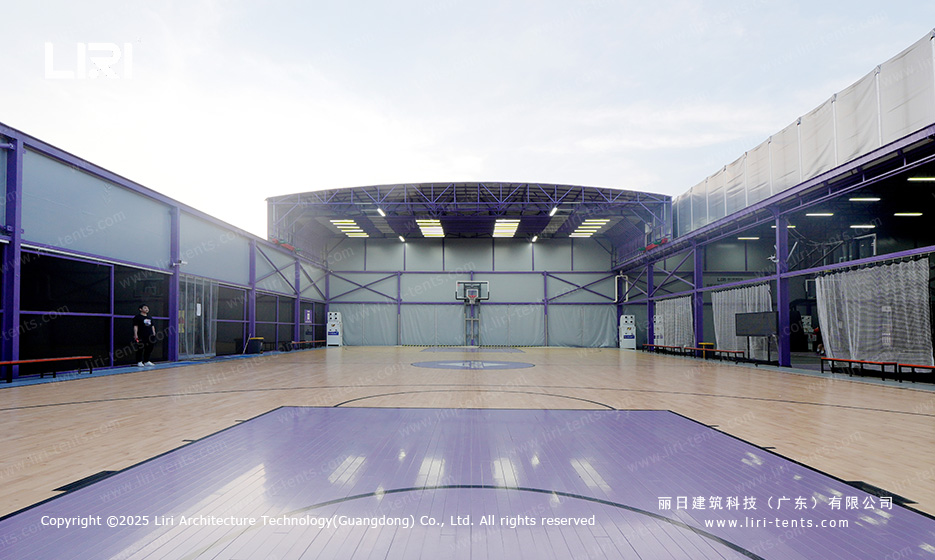
A pair of basketball courts sits on a city rooftop between solar panel arrays. The roof is white PVC over aluminum trusses, painted in a deep violet that runs through the frame. From above, two courts sit side by side under one continuous arched shell. The whole structure is a retractable roof sports venue.
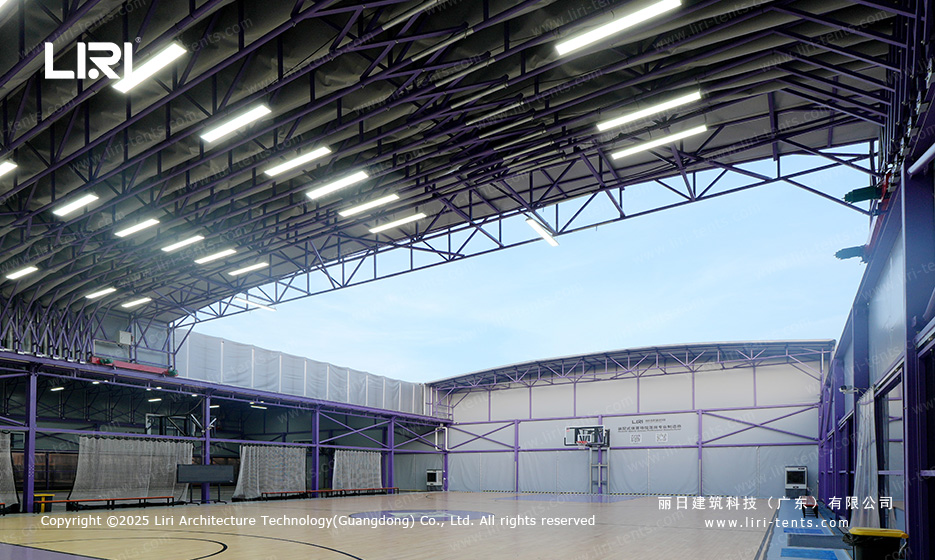
The thing that makes this build different is the twin-linked roof. Two courts share one truss system, but the roof opens in two halves. Each half slides back on its own track. Closed, full indoor court. Open, outdoor court with the trusses exposed. The owner picks between the two with a switch. retractable basketball court tent at Locke Park
Two Basketball Courts, One Sliding Roof, Zero Concrete
The site was already a rooftop, already paved, already served by an elevator and a freight bay. Pouring a concrete block on top would have required structural reinforcement on every floor below, and a permit cycle longer than the operator wanted to wait. A retractable basketball court tent sits on the existing slab with surface-mounted base plates. The structure is the building.
Cost was part of the decision, but not all of it. The per square meter number is lower than a concrete block, and the operator gets two extra benefits on a rooftop: the structure stays light enough that the existing floor loading is fine, and the whole thing can be lifted off in two to three weeks when the lease runs out. earlier clear span basketball court tent at Liuyang
Eight Photos, Two Roof Halves, and the Court You Almost Miss
There are eight photos in the folder. The first three are aerial shots showing the roof in three states: closed, half-open, fully open. The next five are interior shots from each court.
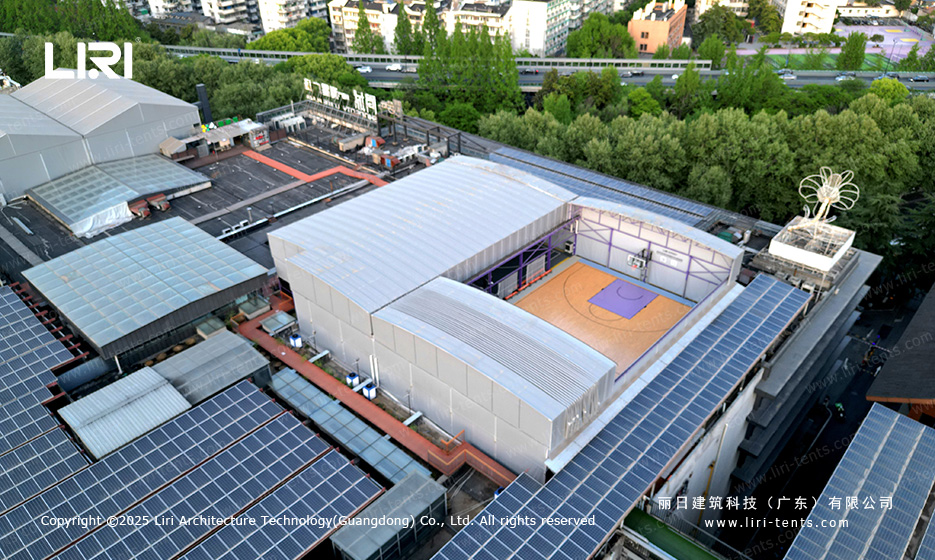
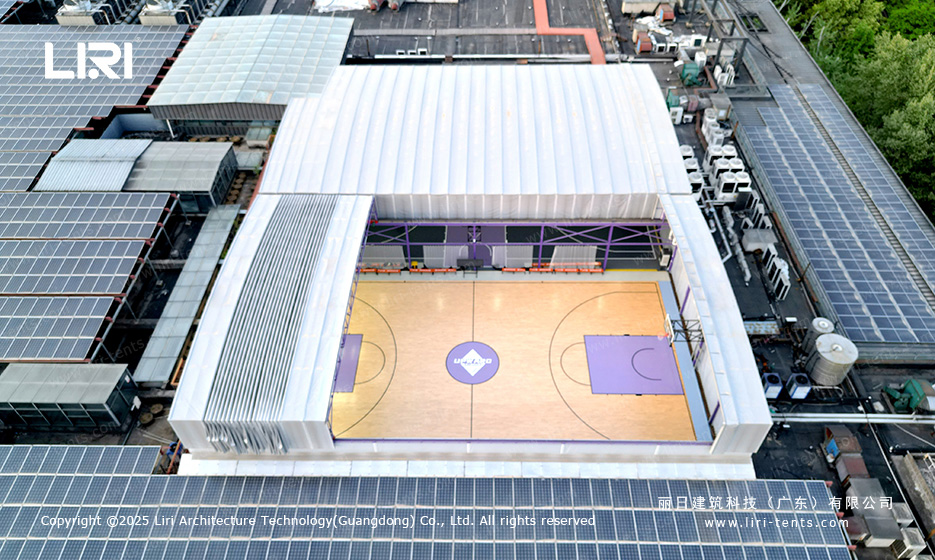
The first aerial shows the whole structure from one corner, with solar panel arrays framing it on three sides. The second shows the roof mid-retraction: one half closed, the other slid back, exposing the courts to the sky. The third is the fully open state, both halves pulled apart. That single photo sequence answers the first question anyone asks: yes, the roof opens, all the way.
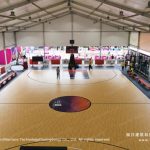
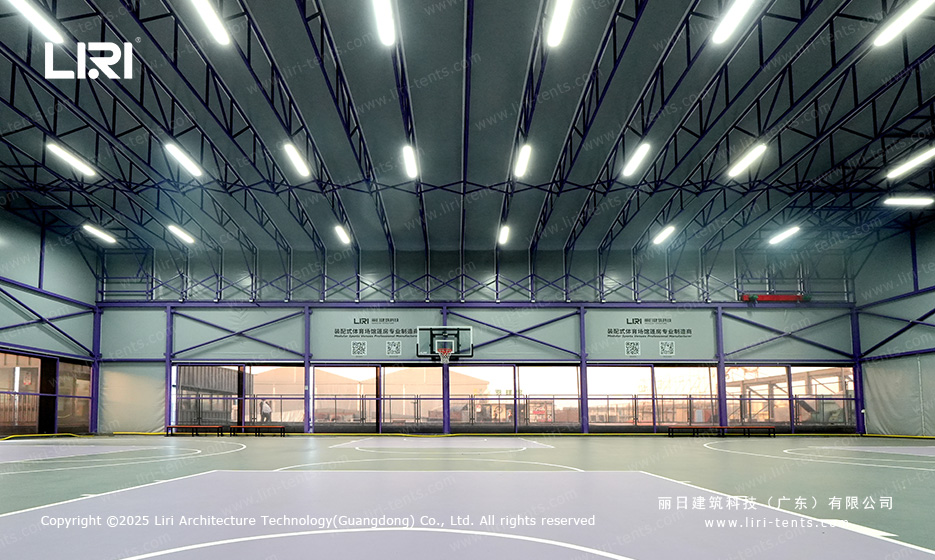
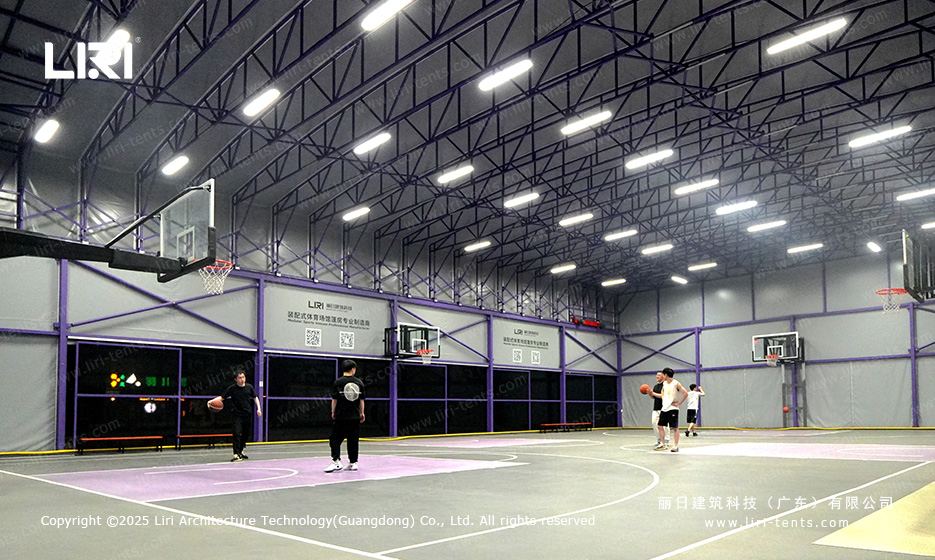
The fourth photo is the wide interior of one court, arched aluminum trusses running the length, LED bars between the trusses, and a basketball hoop at the far end. The fifth shows the second court under the same roof. The sixth and seventh are the glass wall and netting details. The eighth shows players shooting on both courts at the same time.
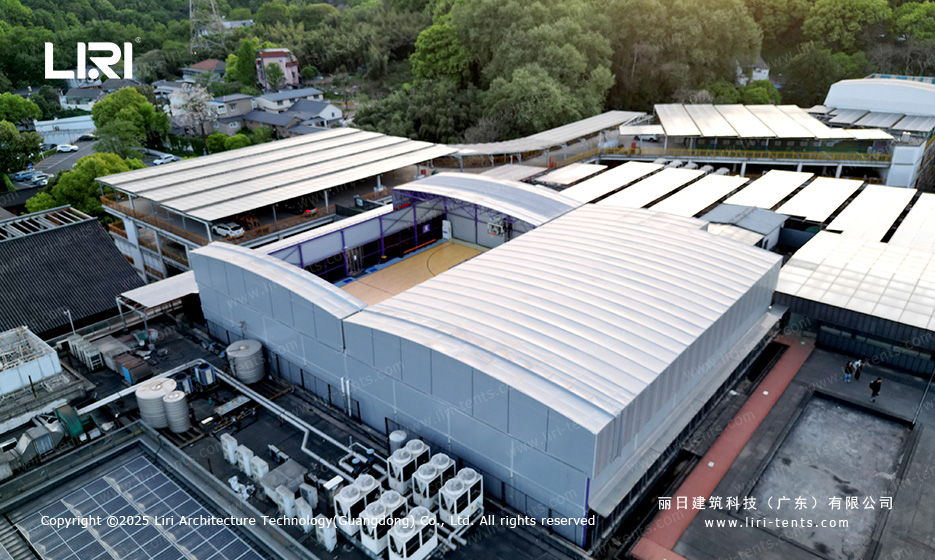
The Twin Layout: Why Two Courts Under One Roof System
The twin layout is what an operator running two courts under one truss system gets. One arched frame, one shared central lighting run, two separate court floors. The hoops face outward at each end, so each court reads as its own playing space. The center of the truss carries both roofs.
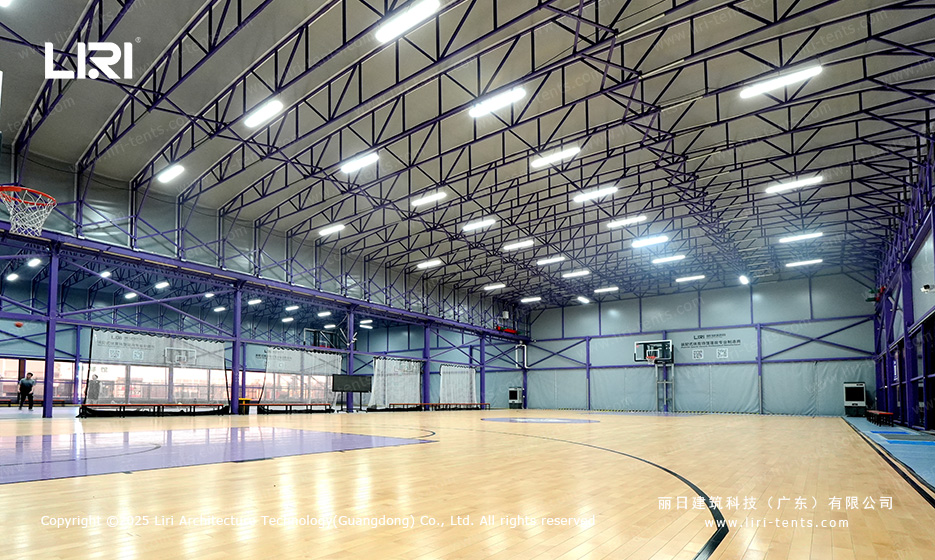
Running two courts under one system changes the cost math in two ways. The truss cost per square meter drops because the span is shared. The roof drive system costs more because there are two sliding halves, but the rail still runs along one track on each side. For an operator who needs two courts and one control room, the twin design is the lower-cost path. basketball court cover tent configurations
There is a tradeoff the marketing photos do not show. When the roof is fully open and rain starts, both courts close at once, because they share one control panel. Two separate single-court roofs could close independently. For most rooftop venues, where rain covers the whole site, this is fine. For a city with sharp localized storms, it is worth asking about.
When an Electric Retractable Roof Beats a Fixed Sports Hall
An electric retractable roof works when the operator needs both indoor and outdoor play on the same court, same day. It works when the venue is on a rooftop or in a courtyard where the operator wants the open-sky feel in summer and the indoor feel in winter.
It does not work when the operator wants to seal the space for HVAC control year-round. A retractable roof sports hall always leaks some air around the seals, and the HVAC load varies with the position of the roof. It also does not work when the local code requires a permanent fire rating. aluminum frame sports arena structures
If the venue is on a rooftop, in a hot-summer city, with mixed indoor-outdoor programming, the retractable roof sports hall is the right call. The owner picked it for exactly those reasons: rooftop, hot summers, two courts, mixed programming. The structure was the lower-cost path to two courts that could each open to the sky. sports tent category
Retractable Basketball Court Tent FAQs: What Sports Venues Ask Us
Below are the questions venue operators and contractors ask us most often about retractable basketball court tents. If you are looking at a single-court fixed-roof build, some answers may not apply.
How does an electric retractable roof basketball court tent actually open?
Two roof halves slide on parallel rails that run along the long sides of the truss. A geared drive motor on each rail pulls the panels back. On a twin-court build like this one, each half opens independently and can stop at any position. A full open-to-close cycle takes three to five minutes.
What is the difference between a retractable sports tent and a permanent concrete sports hall?
A retractable sports tent is a temporary structure by code in most jurisdictions. A concrete sports hall is a permanent building. The retractable version is faster to install and lower per square meter. The concrete version has a longer service life and tighter HVAC control.
Can a retractable basketball court tent handle wind and rain when the roof is open?
When the roof is open, the courts are outdoor courts. The drive system has wind sensors that close the roof automatically above a set threshold, usually around 50 to 60 km/h. The roof closes in three to five minutes, faster than a typical summer storm arrives.
How long does a retractable basketball court tent take to install?
On a prepared slab, the aluminum truss and arch take two to three weeks. The sliding roof panels and drive system add another one to two weeks. The interior fit-out adds three to five weeks. A full open-from-empty-lot scenario for a twin court is roughly eight to twelve weeks.
How much does a retractable basketball court tent cost per square meter?
A twin-court build with electric retractable roof, glass walls, and full interior fit-out runs roughly between USD 280 and USD 450 per square meter, depending on the drive spec, the glass choice, and the floor grade. The single-court volume pricing is lower because the roof drive system is one.